Maintenance and Repairs
Keeping the Flow
Goleta Sanitary District's constant focus is on maintaining the collection system in top condition. Additionally, the District actively promotes responsible use of our system to residents and businesses, whose cooperation is essential to keeping our system operating efficiently and reducing maintenance needs. Residents' and business owners' cooperation in keeping fats, oils, and grease (FOG), toxic substances including medications, and inappropriate items, such as wipes and paper towels, out of the system has helped protect everyone's safety and protecting the environment.
Preventative Maintenance
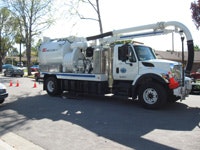
The District carries out a formal plan of preventive maintenance to stop problems before they occur. Pipelines throughout the collection system are cleaned on a routine schedule and then inspected with a closed-circuit television (CCTV) camera so staff can determine where additional maintenance is needed.
The District's combination trucks, (the Vactor and Vaccon), clean wastewater collection pipelines with powerful water jets and debris vacuum systems that eliminate obstructions and prevent sewage spills.
Closed-Circuit Inspection
Field crews use a specially designed closed-circuit television camera that travels through the sewers, providing a detailed visual inspection of the District's pipelines. The system is more cost-effective than digging up a pipeline every time a problem is suspected. If tree roots, for example, are seen growing into a pipe and blocking the flow of wastewater (a common problem), the jet rodder tool can slice through the roots with water, clearing the pipe.
Digital Mapping
The District uses a computer system called Geographic Information System (GIS) to create digital maps with accurate locations of roads, pipelines, and buildings. Residents within the Goleta Sanitary District boundary can receive a printout of their sewer line connection.
Asset Management Plant
The District uses an asset management tool to identify which assets (everything from District vehicles, to sewer mains, to pumps, to vehicles and pumps) need future repairs or maintenance, and to estimate each asset's lifecycle so we can prepare for capital expenses as part of an organized Capital Improvement Plan. This way, the District can stay on top of potential areas of concern before they become critical. Having a robust asset management plan also allows the District to manage expenses in a way that focuses capital expenditures on where they need to be, when they need to be. As a result, the District is well-positioned for the long-term sustainability of our infrastructure.